What Are the Key Findings on Prop Firm Drawdown Rules?
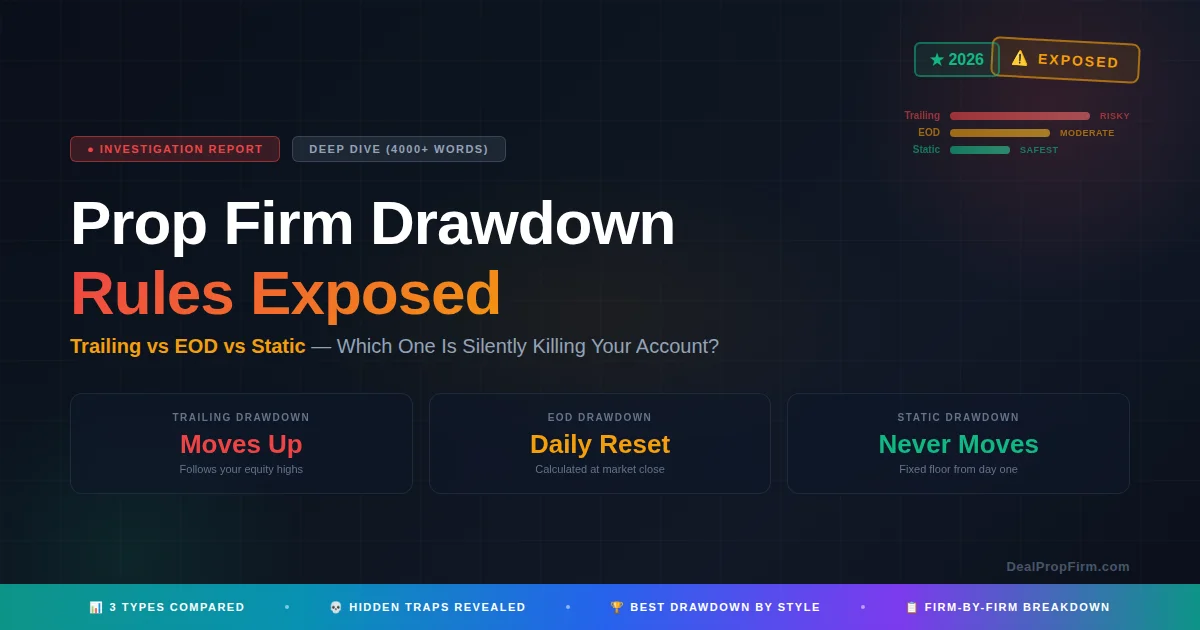
Our reading of 21 prop firms reveals three distinct drawdown systems: Trailing (Intraday and EOD), Static, and Hybrid. EOD Trailing is the dominant model in 2026, used by 7 of the top 10 futures firms. Static drawdown remains the most common choice among forex-focused firms, though several of them — FTMO included — run a trailing limit on at least one product line.
Drawdown rules determine when your funded account gets terminated. Misunderstanding them is the #1 cause of funded account violations — ahead of bad trades, emotional decisions, or rule-breaking. This report gives you the complete picture.
We categorized every major prop firm by drawdown type, analyzed how each system works under real trading conditions, and ranked them by trader-friendliness. The results are clear: not all drawdown rules are created equal.
Key Findings
- 1.End-of-day trailing is the futures norm — 9 of the 28 programs we checked use it
- 2.Static drawdown is the forex norm, not the forex rule — 16 of the 18 forex programs we checked are static, the rest trail
- 3.Only 3 firms offer NO daily loss limit: Apex Trader Funding, Lucid Trading (Flex 25K), and DNA Funded
- 4.Intraday trailing is the cheapest but most aggressive option — Apex from $16.70 with code DEALPROPFIRM
- 5.The "buffer rule" on withdrawals is the #1 hidden trap — it affects 80% of trailing drawdown firms and catches traders off guard
Whether you're a scalper, day trader, or swing trader, the drawdown type you choose will fundamentally change your risk profile. Read on for the full breakdown, simulations, and our ranked recommendations.
What Are the 3 Types of Drawdown in Prop Trading?
Prop firm drawdown rules fall into three categories: Trailing drawdown (moves up with your profits, never down), Static drawdown (fixed maximum loss that never changes), and Hybrid systems (choose your type or switch between phases). Each type fundamentally changes how you must trade.
Understanding these three systems is essential before you fund any account. Here's exactly how each one works, who uses it, and who it's best for.
Trailing
How it works: Your drawdown floor moves up as your account reaches new highs. It never moves down. Two sub-types: Intraday (updates every tick) and EOD (updates at market close).
Who uses it: Apex, Bulenox, E8 Markets, Earn2Trade, FTMO, LucidPro, MyFundedFutures, Take Profit Trader, Topstep, Tradeify
Best for: Day traders, scalpers, futures traders
Static
How it works: Fixed percentage from your starting balance. Never moves up or down, regardless of profits. A 10% drawdown on $100K always means your floor is $90K.
Who uses it: Alpha Capital, AquaFunded, Atlas Funded, Blue Guardian, BrightFunded, E8 Markets, FTMO, Funded Trading Plus, FundedNext, FundingPips, FXIFY, Hola Prime, The5ers
Best for: Beginners, swing traders, news traders
Hybrid
How it works: Choose your drawdown type or switch between phases. Some firms let you pick weekly; others change rules between evaluation and funded stages.
Who uses it: Apex, Bulenox
Best for: Experienced traders who want flexibility
The shift toward EOD Trailing is the biggest trend in 2026. It offers a middle ground: your threshold moves with profits (rewarding good trading) but only updates once per day (protecting you from intraday volatility). Seven of the top ten futures prop firms now use this model.
Static drawdown is most at home among forex prop firms, where a continuous 24/5 market makes a fixed threshold simpler to enforce than a daily recalculation. It is not a clean split, though: 2 of the 18 forex programs in our table run a trailing drawdown, and FTMO itself uses one on its one-step product while keeping a static limit on its two-step. Naming a firm without naming the program is what makes most published comparisons wrong.
How Does Trailing Drawdown Actually Work?
Trailing drawdown tracks your account's highest point (high-water mark) and sets a maximum loss below it. If your $50,000 account peaks at $52,000, your drawdown floor rises to $49,000 (with a 6% trail). The critical difference is WHEN it updates: intraday trailing updates every tick, EOD trailing updates once at market close.
Trailing drawdown is the most misunderstood rule in prop trading. Traders lose funded accounts not because they had a bad day, but because they didn't understand when their threshold moved. Let's walk through a concrete example.
Real Example: $50K Account, 6% Trailing Drawdown
A trader starts with a $50,000 account and a 6% trailing drawdown ($3,000). They make $2,000 in the morning, then lose $1,500 in the afternoon. Here's how the two trailing types handle it differently:
| Event | Intraday Trailing | EOD Trailing |
|---|---|---|
| Start of day | Balance: $50,000 | Floor: $47,000 | Balance: $50,000 | Floor: $47,000 |
| Morning: +$2,000 profit | Floor jumps to $49,000 | Floor stays at $47,000 |
| Afternoon: -$1,500 loss | Balance: $50,500 | Cushion: $1,500 | Balance: $50,500 | Cushion: $3,500 |
| End of day close | Floor: $49,000 (locked at peak) | Floor updates to $47,500 (EOD balance - 6%) |
Critical Difference
During the afternoon drawdown, the intraday trader had only $1,500 of cushion while the EOD trader still had $3,500. One more bad trade during that afternoon reversal could have violated the intraday trailing account — even though both traders ended the day at the same P&L. This is why EOD trailing is considered significantly safer.
The Buffer Rule: The Withdrawal Trap
Here's what catches most traders: when you withdraw profits, your trailing drawdown threshold does NOT decrease. Your high-water mark is locked in.
Buffer Rule Example
Account peaks at $52,000. Trailing floor is at $49,000 (6% trail). Cushion: $3,000.
You withdraw $1,000. Account balance: $51,000. Floor stays at $49,000.
Your new cushion: $2,000 (down from $3,000).
The withdrawal shrank your safety net by 33% without changing your risk threshold. This is the #1 surprise that kills funded accounts.
Firms using the buffer rule include Apex Trader Funding, Topstep, Tradeify, and most other trailing drawdown firms. Always check the buffer rule before your first withdrawal.
How Does Static Drawdown Work and Why Do Traders Prefer It?
Static drawdown sets a fixed maximum loss from your starting balance that never changes regardless of profits. On a $100K FTMO two-step account, whose 10% drawdown is static, your floor is always $90,000 — whether you're at $100K or $115K. This gives consistent risk management and is simpler to calculate.
Static drawdown is the simplest system to understand. Your maximum loss is a fixed number, set once, and it never changes. No high-water marks, no trailing, no surprises.
Static vs Trailing: Same Scenario, Different Outcomes
Using the same $50,000 account example: a trader grows the account to $55,000 over two weeks, then has a losing streak of $4,000. Here's the difference:
Static (6%)
Floor: $47,000 (always)
Peak balance: $55,000
After -$4,000: balance $51,000
Cushion: $4,000
Safe. Floor never moved.
Trailing (6%)
Floor at peak: $51,700 ($55K - 6%)
Peak balance: $55,000
After -$4,000: balance $51,000
Cushion: -$700 (VIOLATED)
Account terminated. Trail caught up.
This is why beginners and swing traders gravitate toward static drawdown. The math is predictable: your floor never changes, so a winning streak actually increases your safety cushion instead of raising your risk threshold.
Firms Using Static Drawdown
16 of the 28 programs in our table use a static limit, across 13 firms: Alpha Capital, AquaFunded, Atlas Funded, Blue Guardian, BrightFunded, E8 Markets, FTMO, Funded Trading Plus, FundedNext, FundingPips, FXIFY, Hola Prime, The5ers. Each of those rows links to the firm’s own documentation in the full comparison below.
We deliberately do not publish a percentage for each firm here. A maximum drawdown quoted as a percentage means different things depending on whether it is measured against the starting balance, the highest balance reached, or the current equity — and the firms that state it least precisely are the ones where the difference matters most. The model, which is what we verify, tells you more than the number.
Which Prop Firms Use Which Drawdown Type?
Across 28 evaluation programs at 21 firms, 16 use a static drawdown and 12 use a trailing one. Of the trailing programs, 9 recalculate at the session close and 2 recalculate intraday. Every row below links to the firm’s own documentation and carries the date we last read it.
Grouped by how the limit behaves rather than by firm, because that is what decides whether a rule is survivable. The intraday group comes first: it is the one that can move your floor on profit you never banked.
| Firm | Program | Market | Limit measured in | Source |
|---|---|---|---|---|
| Trailing, recalculated intraday · 2 programs | ||||
| Apex | Evaluation (intraday trail) | futures | fixed dollar | docs · 2026-08-23 |
| Bulenox | Qualification Option 1 (intraday) | futures | fixed dollar | docs · 2026-08-23 |
| Trailing, recalculated at the session close · 9 programs | ||||
| Apex | Evaluation (end-of-day trail) | futures | fixed dollar | docs · 2026-08-23 |
| Bulenox | Qualification Option 2 (EOD) | futures | fixed dollar | docs · 2026-08-23 |
| Earn2Trade | Trader Career Path | futures | fixed dollar | docs · 2026-08-23 |
| FTMO | 1-Step | forex | percent of account size | docs · 2026-08-14 |
| LucidPro | Evaluation | futures | not verified | docs · 2026-08-17 |
| MyFundedFutures | Rapid | futures | fixed dollar | docs · 2026-08-23 |
| Take Profit Trader | Test | futures | fixed dollar | docs · 2026-08-23 |
| Topstep | Trading Combine | futures | fixed dollar | docs · 2026-08-23 |
| Tradeify | Growth Evaluation | futures | fixed dollar | docs · 2026-08-23 |
| Static · 16 programs | ||||
| Alpha Capital | Pro 8% | forex | — | docs · 2026-08-14 |
| AquaFunded | 2-Step | forex | — | docs · 2026-08-17 |
| Atlas Funded | 2 Step | forex | — | docs · 2026-08-17 |
| Blue Guardian | 2 Step Standard | forex | — | docs · 2026-08-14 |
| BrightFunded | 2-Step Classic | forex | — | docs · 2026-08-17 |
| E8 Markets | E8 Pro | forex | — | docs · 2026-08-14 |
| FTMO | 2-Step | forex | — | docs · 2026-08-14 |
| Funded Trading Plus | 2-Step Classic | forex | — | docs · 2026-08-14 |
| FundedNext | Stellar 2-Step | forex | — | docs · 2026-08-14 |
| FundedNext | Stellar 1-Step | forex | — | docs · 2026-08-14 |
| FundingPips | 2 Step Standard | forex | — | docs · 2026-08-14 |
| FundingPips | 2 Step Pro | forex | — | docs · 2026-08-14 |
| FundingPips | 1 Step Flex | forex | — | docs · 2026-08-14 |
| FXIFY | Three Phase | forex | — | docs · 2026-08-14 |
| Hola Prime | 2-Step Pro | forex | — | docs · 2026-08-23 |
| The5ers | High Stakes | forex | — | docs · 2026-08-14 |
| Trailing, recalculation not stated clearly in public documentation · 1 program | ||||
| E8 Markets | E8 One | forex | percent of account size | docs · 2026-08-14 |
Scope: 28 programs at 21 firms, last verified 2026-08-23. This is a documented sample, not a census of the industry, and a firm absent from the table is absent because we have not verified it — not because it has no drawdown rule. Firms that have since closed are not listed. Base table contributed by Danil Vaimer (Consistry).
What the split actually shows
The market divide is real but softer than it is usually described. 10 of the 10 futures programs here use a trailing drawdown, against 2 of the 18 forex programs. Futures markets have a defined session close, which makes an end-of-day recalculation straightforward; forex runs continuously, so a fixed threshold is simpler to enforce.
What the usual summary misses is that several firms run both models side by side, on different product lines — the same firm can sell you an intraday trail or an end-of-day trail depending on which account you click. The model is a property of the program you bought, not of the company logo, and that is why this table lists programs rather than firms.
What Happens to Your Account? Same Trade, 3 Different Rules
We simulated the exact same trading day across all three drawdown types to show the real impact. A trader on a $50,000 account makes $2,000 in the morning, gives back $1,500 in the afternoon, then closes flat at +$500. The results are dramatically different depending on drawdown type.
Numbers don't lie. Here's a tick-by-tick breakdown of the same trading day under all three drawdown systems. The account starts at $50,000 with a 6% maximum drawdown ($3,000).
| Event | Intraday Trailing | EOD Trailing | Static |
|---|---|---|---|
| Start | $50,000 | $50,000 | $50,000 |
| Floor at start | $47,000 (6%) | $47,000 (6%) | $47,000 (6%) |
| Morning: +$2,000 | Floor → $49,000 | Floor stays $47,000 | Floor stays $47,000 |
| Afternoon: -$1,500 | $50,500 Cushion: $1,500 | $50,500 Cushion: $3,500 | $50,500 Cushion: $3,500 |
| Close: +$500 net | Floor → $47,500 | Floor → $47,500 | Floor stays $47,000 |
| Cushion at Close | $3,000 | $3,000 | $3,500 |
| Next Day Risk | Higher (threshold moved) | Same as intraday | Safest (never moves) |
The Hidden Danger
On the worst moment of this simulation, the intraday trailing trader had only $1,500 cushion vs $3,500 for EOD and Static. One bad trade during the afternoon reversal could have triggered a violation ONLY on intraday trailing — even though all three ended at the same P&L. This is not a theoretical risk. It is the exact scenario that causes the majority of funded account violations on intraday trailing platforms.
The simulation reveals a key insight: all three drawdown types end the day in similar positions, but the intraday journey is where accounts live or die. If you trade with volatile intraday swings — morning momentum followed by afternoon reversals — intraday trailing is significantly more dangerous than EOD or static.
Which Drawdown Type Is Best for Your Trading Style?
Your ideal drawdown type depends entirely on how you trade. Scalpers benefit from intraday trailing's lower cost. Swing traders need EOD or static to survive overnight gaps. Day traders should choose EOD trailing for the best balance of flexibility and safety.
There is no universally "best" drawdown type — only the best type for you. Here are our recommendations based on four common trading styles.
Scalper
Fast in, fast out. Positions last seconds to minutes. Small targets, tight stops.
Recommended: Intraday Trailing or EOD Trailing
Threshold moves don't hurt scalpers because positions close quickly. The lower cost of Apex ($16.70) makes intraday trailing viable for this style.
Day Trader
Holds positions for hours within the same session. Closes everything before market close.
Recommended: EOD Trailing
Intraday swings won't affect your threshold until close. Lucid Trading and Tradeify are ideal for this approach.
Swing Trader
Holds positions overnight or for multiple days. Profits from larger moves.
Recommended: Static or EOD Trailing
Overnight gaps are the enemy of intraday trailing. A static drawdown is the safest choice — on the forex side, where 16 of the 18 programs we checked use one (The5ers, and FTMO on its two-step product). On futures none of the 10 programs here is static, so an end-of-day trail is the safest available: it resets at the close.
News Trader
Trades around economic releases (NFP, CPI, FOMC). High volatility, fast moves.
Recommended: Static ONLY
Volatility spikes can push your account to temporary highs, ratcheting up the trailing threshold before snapping back. Static drawdown (FTMO, Lux) is the only safe option for news-based strategies.
If you're unsure of your trading style, start with EOD trailing. It provides the best balance of flexibility (your threshold doesn't move during the day) and accountability (it does update at close, rewarding consistent profitability). Most funded traders in 2026 operate under EOD trailing rules.
Which Prop Firm Has the Best Drawdown Rules? Our Picks
Based on our analysis, the best drawdown rules depend on your priority. For maximum freedom: Apex Trader Funding (no daily loss limit on its end-of-day line — note it also sells an intraday trail, from $16.70). For simplicity: FTMO’s two-step account, whose 10% drawdown is static. For fastest payouts with safe rules: Lucid Trading (end-of-day trailing, no daily loss on 25K, ~15-minute payouts from $55.30).
Expert Verdict
15+ Years ExperienceBy Jonathan Jean-Philippe • Professional Trader & Prop Firm Analyst
After reading the rules of 21 firms, end-of-day trailing with no daily loss limit is the most trader-friendly drawdown system in 2026. It gives you intraday freedom while protecting against overnight gaps. Apex and Lucid lead this category.
💡 My Recommendation:
Start with Apex Trader Funding ($16.70 with code DEALPROPFIRM) if you want the cheapest entry with no daily loss limit — choosing its end-of-day line rather than its intraday one. If you want faster payouts, choose Lucid Trading ($55.30 with DEALPROPFIRM). For beginners who want simplicity, the static 10% drawdown on FTMO's two-step account is the safest to learn on.
⚠️ Watch Out:
Avoid intraday trailing unless you're an experienced scalper. The real-time threshold movement has caused more funded account violations than any other drawdown type. And always check the buffer rule before your first withdrawal — it's the #1 surprise that kills funded accounts.
Note: This review is independent, but I may receive a commission if you use my links, which helps fund my €200K+ testing lab.
Ready to Start?
Use code DEALPROPFIRM at checkout for the current Apex Trader Funding discount.
Ready to Start?
Use code DEALPROPFIRM at checkout for the current Lucid Trading discount.
FTMO Pricing
We don't currently list a verified discount code for FTMO. See the real pricing before you buy.
For a complete list of current promos and discounts across all prop firms, visit our Deals page. We update promo codes daily and verify every discount before publishing.
Frequently Asked Questions
Q: What is trailing drawdown in prop trading?
A trailing drawdown moves your maximum loss threshold upward as your account reaches new highs, instead of leaving it at the starting balance. Two versions exist and the difference between them is the whole subject: an intraday trail follows your equity as it moves, so unrealised profit raises the floor immediately, while an end-of-day trail only recalculates once the session has closed. Several firms sell both, on different product lines, so the model is a property of the account you bought rather than of the firm.
Q: What is the difference between EOD and intraday trailing drawdown?
Intraday trailing updates continuously during the trading day, so unrealised profit immediately raises your drawdown floor — a spike you never banked can permanently move the level you must stay above. End-of-day trailing only recalculates at the close, which means your floor is fixed for the whole session and you know it before you place a trade. For the same account size and the same headline percentage, the intraday version is materially harder to survive.
Q: Which prop firm has the easiest drawdown rules?
There is no single answer, because the same firm can sell an easy account and a hard one. What actually makes a rule forgiving is the combination of three things: an end-of-day or static drawdown rather than an intraday trail, no daily loss limit or a generous one, and a floor that stops trailing once it reaches the starting balance. Apex and Lucid are commonly cited for the absence of a daily loss limit on some of their accounts — but Apex sells an intraday-trail line as well as an end-of-day one, so the account you choose matters more than the firm you choose.
Q: Is static or trailing drawdown better?
Static is simpler to manage: the floor never moves, so once you are ahead you are genuinely ahead, and that predictability suits anyone still learning the rules. Trailing is not automatically worse — an end-of-day trail that locks once it reaches the starting balance behaves much like a static limit after your first good stretch. The version to understand before you buy is the intraday trail. Note that a firm is rarely one or the other: FTMO, for instance, runs a trailing drawdown on its one-step product and a static one on its two-step, so naming a firm without naming the program says almost nothing.
Q: What is the buffer rule in prop trading?
The buffer rule means that when you withdraw profits, your trailing drawdown threshold does not come back down with your balance. Your high-water mark stays where it was, so the withdrawal reduces your cushion without lowering your floor. It is the reason a payout can leave a funded account closer to a breach than it was the day before, and it is worth checking before you plan a withdrawal schedule.
Q: Which drawdown type is best for swing traders?
An end-of-day trail or a static limit. Swing traders hold positions overnight, and an intraday trail is hostile to that: unrealised profit during the session raises the threshold, and an overnight gap can then breach a level that only exists because of profit you never took. An end-of-day trail updates once, at the close, and a static limit never moves at all. Check the overnight-holding rule at the same time — some firms that allow the position still measure the drawdown against you while it is open.
Sources
• DealPropFirm drawdown table — 28 programs at 21 firms, each with its source, last verified 2026-08-23
• Apex Trader Funding — Official Rules & T&Cs
• FTMO — Official Trading Objectives
• Lucid Trading — Official Program Rules
• Topstep — Official Drawdown Policy
• Tradeify — Official Account Rules
• The5ers — Official Risk Parameters
• Trustpilot — Aggregate review data across all analyzed firms
• DealPropFirm internal testing data (2024-2026) — funded account simulations and rule verification