1. What Changed at Apex Trader Funding in March 2026?
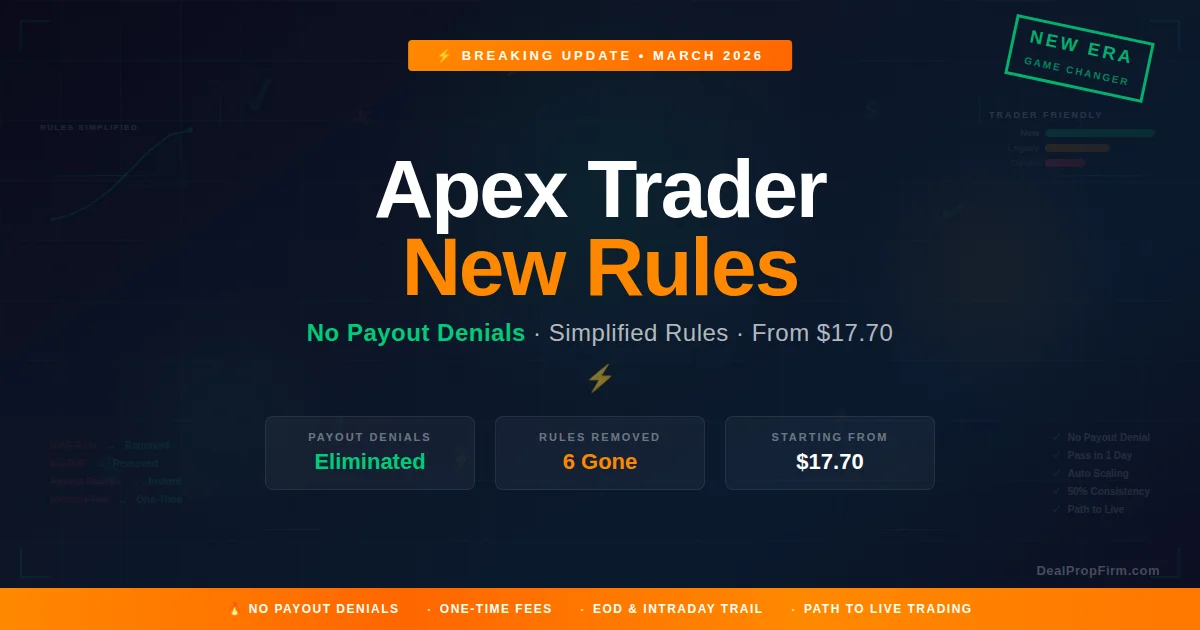
On March 1, 2026, Apex Trader Funding launched a new product line that fundamentally changes how their evaluations work. This isn't a minor tweak — it's a complete overhaul of the evaluation experience. Here's the summary:
For context, Apex has been the most popular futures prop firm for over three years running. With more than 300,000 funded accounts distributed and an industry-leading 90/10 profit split, they dominate the market. But that dominance came with growing pains — payout denials, complex rules that even experienced traders found confusing, and a subscription model that quietly drained accounts month after month. The March 2026 update addresses every single one of those pain points.
The timing isn't accidental either. With competitors like Topstep, Take Profit Trader, and Tradeify all improving their offerings, Apex needed to make a statement. This update is that statement — and it's one of the most aggressive pro-trader moves we've seen from any major firm.
What's New
- + One-time fees (no recurring subscription)
- + Two drawdown types: EOD Trail & Intraday Trail
- + No payout denials — automated processing
- + Simplified rules (6 rules eliminated)
- + Pass in as little as 1 day
- + Path to Live Trading announced
What's Gone
- - Monthly subscriptions
- - Resets (no longer available on new products)
- - 250K and 300K account sizes
- - MAE rule, 5:1 R:R rule, one-direction rule
- - Manual payout review process
- - Minimum 7 trading days requirement
The bottom line: this is the most pro-trader move we've seen from any major prop firm. The elimination of payout denials alone is massive — but combined with rule simplification and one-time fees, Apex is signaling a clear shift toward transparency.
What makes this update particularly notable is that Apex didn't just tweak pricing or add a marketing gimmick. They redesigned the fundamental relationship between the firm and its traders. The old model was "pay monthly, follow complex rules, hope your payout gets approved." The new model is "pay once, follow simple rules, get paid automatically." That's a philosophical shift, not just a product update.
2. EOD Trail vs Intraday Trail — Which One Is Better?
The new products offer two drawdown calculation methods. Understanding the difference is critical to choosing the right account type for your trading style.
Think of it this way: Intraday Trail is like a shadow that follows your every step in real time — every time you reach a new profit peak during the session, the floor rises with you. EOD Trail is like a checkpoint system — the floor only updates once per day at market close, giving you freedom to have unrealized gains and pullbacks during the session without your drawdown moving. Each approach has real consequences for how you manage risk and which strategies you deploy.
Intraday Trail Explained
The trailing drawdown follows your peak balance in real-time. Every tick your balance reaches a new high, the drawdown floor moves up with it. This means the drawdown is constantly adjusting during the trading session.
Advantages
- + No daily loss limit — trade freely
- + Cheaper pricing than EOD
- + Maximum intraday flexibility
Disadvantages
- - Trailing is aggressive (every tick counts)
- - Can lose drawdown room quickly on volatile moves
- - Must watch balance closely during trades
EOD Trail Explained
The drawdown is recalculated once per day at market close. During the trading session, your drawdown floor stays fixed regardless of how high your balance goes. This provides much more predictability, but comes with a fixed Daily Loss Limit (DLL) per session.
Advantages
- + Drawdown doesn't move during session
- + Know exactly how much you can lose per day
- + More predictable risk management
Disadvantages
- - Daily Loss Limit restricts flexibility
- - More expensive than Intraday
- - DLL can stop you out on volatile days
Side-by-Side Comparison
| Feature | Intraday Trail | EOD Trail |
|---|---|---|
| Drawdown Calculation | Real-time (tick by tick) | Once per day (at close) |
| Daily Loss Limit | None | Yes (fixed per session) |
| Price (100K) | ~$39.90 | ~$39.90 |
| Best For | Scalpers, aggressive day traders | Swing traders, positional |
| Risk Level | Higher (trailing is aggressive) | Lower (more predictable) |
Real-World Scenario: How Drawdown Hits Different
Say you're trading the ES (S&P 500 E-mini) on a 100K account with a $3,000 trailing drawdown. Your starting balance is $100,000, which means your initial floor is $97,000.
You enter a long position. The market rallies and your unrealized P&L peaks at +$1,200. Then the market pulls back and you close the trade at +$600.
Intraday Trail Result
Your balance peaked at $101,200 during the trade (unrealized). The drawdown floor moved up to $98,200 in real time. After closing at +$600, your balance is $100,600 — and your floor is now $98,200. You've lost $600 of drawdown room even though you made a profitable trade.
EOD Trail Result
The unrealized peak of $101,200 is ignored until market close. You close the trade at +$600, and at end of day your balance is $100,600. The drawdown floor only then moves to $97,600. You keep the full $3,000 drawdown room relative to your closing balance.
This is why Intraday Trail is cheaper — the aggressive real-time trailing eats into your drawdown room on every winning trade that has any pullback. EOD Trail protects you from intraday fluctuations.
Our Recommendation
Scalpers / aggressive day traders: Intraday Trail. No daily loss limit gives you maximum freedom, and the lower price means cheaper retries.
Swing / positional traders: EOD Trail. The drawdown only moves at market close, so you know exactly where your floor is during the session.
On a tight budget: Intraday Trail. Starting at ~$16.70 for a 25K account, it's the cheapest entry point at Apex.
3. How Much Does Apex Trader Funding Cost Now?
Both new product types are one-time purchases. No monthly subscription, no recurring charges. Use code DEALPROPFIRM for approximately 90% off.
This is a fundamental shift from the traditional prop firm business model. Under the old subscription system, a trader who took three months to pass a 100K evaluation would pay $133.65 (at discounted rates). With the new one-time model, that same trader pays ~$39.90 — period. Even if you need to buy multiple evaluations after failing, the one-time model is typically cheaper unless you fail more than 3 times at the same size.
The pricing structure also reveals Apex's strategy: they want volume over retention. Instead of keeping traders on recurring plans for months, they're betting that cheap one-time fees will attract more traders overall — and that the simplified rules will lead to more funded accounts and PA fee revenue downstream.
Intraday Trail Pricing (Rithmic)
| Size | Normal | With DEALPROPFIRM | Target | Drawdown | Contracts |
|---|---|---|---|---|---|
| 25K | $118 | ~$16.70 | $1,500 | $1,000 | 4 mini |
| 50K | $131 | ~$24.90 | $3,000 | $2,000 | 6 mini |
| 100K | $198 | ~$39.90 | $6,000 | $3,000 | 8 mini |
| 150K | $265 | ~$59.90 | $9,000 | $4,000 | 12 mini |
EOD Trail Pricing (Rithmic)
| Size | Normal | With DEALPROPFIRM | Target | Drawdown | Contracts | DLL |
|---|---|---|---|---|---|---|
| 25K | $177 | ~$16.70 | $1,500 | $1,000 | 4 mini | $500 |
| 50K | $249 | ~$24.90 | $3,000 | $2,000 | 6 mini | $1,000 |
| 100K | $399 | ~$39.90 | $6,000 | $3,000 | 8 mini | $1,500 |
| 150K | $599 | ~$59.90 | $9,000 | $4,000 | 12 mini | $2,000 |
3-Month Cost: Legacy vs New
Legacy accounts are monthly subscriptions. New accounts are one-time. Over 3 months, the math clearly favors the new products:
Legacy 100K (3 months)
Month 1: $39.90 (with DEALPROPFIRM)
Month 2: $39.90
Month 3: $39.90
Total: $119.70
New Intraday 100K (one-time)
Purchase: ~$39.90 (with DEALPROPFIRM)
Month 2: $0
Month 3: $0
Total: ~$39.90 (78% savings)
* New accounts expire after 30 days. If you fail, you buy a new one. But if you pass, there are no more fees — ever.
4. What Rules Changed Between Legacy and New Apex Products?
Apex eliminated six rules from the new EOD Trail and Intraday Trail products, including the MAE rule, the 5:1 risk-reward requirement, and the one-direction rule. The minimum trading days dropped from seven to one, and payout denials were completely removed. Legacy accounts retain all original rules unchanged.
| Rule | Legacy | New Products |
|---|---|---|
| MAE (30% Negative P&L) | Active | Removed |
| 5:1 Risk-Reward Rule | Active | Removed |
| One Direction Rule | Active | Removed |
| Payout Denials | Manual review | Eliminated |
| Min Trading Days | 7 days | 1 day |
| Consistency Rule (PA) | 30% | 50% |
| Resets | Available ($65) | Not available |
| Expiration | None (recurring) | 30 days |
| Max Account Size | $300K | $150K |
| Drawdown Type | Trailing only | EOD or Intraday Trail |
The 50% consistency rule change is worth noting. In Legacy, no single day can exceed 30% of your total profits. In new products, that threshold rises to 50%. This means you have more room for standout days, but you still can't have a single lucky trade carry your entire account.
Let's talk about the rules that were removed and why they mattered. The MAE (Maximum Adverse Excursion) rule flagged trades where the unrealized loss exceeded 30% of the final profit — essentially penalizing traders who held through drawdowns before a trade turned profitable. This was one of the most controversial rules because it punished a common and often successful trading approach: letting a trade work through volatility. Its removal means you can now hold trades through deeper pullbacks without risking a rule violation.
The 5:1 Risk-Reward rule required that your risk (stop loss) couldn't exceed 5 times your reward (take profit) on any single trade. This was designed to prevent "lottery ticket" trading — massive stops with tiny targets. But in practice, it interfered with legitimate strategies like news trading, breakout entries with wide stops, or any approach where the initial stop was generous. Removing it gives traders significantly more flexibility in structuring their entries.
The One Direction rule prevented traders from holding both long and short positions in the same instrument simultaneously. While hedging was already prohibited, this rule went further by restricting rapid directional switches. Its removal means you can now quickly reverse positions without worrying about triggering a violation — a significant improvement for scalpers and news traders.
The 30-day expiration is the most significant new constraint. Legacy evaluations have no time pressure — you can take months to pass. New products give you exactly 30 calendar days, which means roughly 21-22 trading days depending on holidays. For experienced traders this is plenty of time, but for beginners still developing consistency, it adds real pressure. Factor this into your decision when choosing between Legacy and the new products.
5. Did Apex Trader Funding Really Eliminate Payout Denials?
If there's one change that matters more than any other, it's this. Payout denials have been the single biggest source of frustration in the prop trading industry. Traders pass evaluations, generate profits, request payouts — and then get denied for obscure rule violations discovered after the fact.
The denial problem wasn't unique to Apex. Across the industry, firms like Funded Engineer, FundedFirm, and others have faced serious allegations about systematic payout denials. Our PropFiles investigations have documented cases where traders waited weeks for payouts only to be told they violated a rule they didn't know existed. Apex's decision to eliminate denials entirely isn't just a product improvement — it's a direct response to the trust crisis in the industry.
What Caused Payout Denials (Old System)
- x Video review of trading sessions (subjective)
- x Screenshot verification (easy to miss rules)
- x Manual approval by staff (delays + human error)
- x Retroactive rule enforcement (rules applied after trades)
- x Vague rule interpretations (MAE, one-direction, 5:1 R:R)
How the New System Works
With the new products, the payout process is fully automated. Meet the objective criteria, request a payout, and it processes. No manual review, no screenshots, no video analysis.
This is possible because the simplified rules are 100% quantifiable — there's no room for subjective interpretation. Either you met the drawdown limits or you didn't. Either you hit the profit target or you didn't.
For comparison, competitors like Take Profit Trader and Topstep still use manual review processes. Apex is the first major firm to completely eliminate the denial workflow. This is a competitive advantage that's hard to overstate.
The psychological impact of this change cannot be underestimated. Under the old system, even after passing an evaluation and generating profits in a PA account, traders operated under a cloud of uncertainty. "Will my payout get approved?" was a constant background worry that affected decision-making. Some traders reported changing their trading style — taking smaller profits, avoiding certain strategies — just to avoid triggering an obscure rule during the review process.
With automated payouts, that psychological burden is gone. You trade your strategy, meet the quantifiable criteria, and get paid. The simplicity of the new system should actually lead to better trading performance because traders can focus entirely on the market instead of worrying about post-hoc rule interpretations.
6. What Are the Trade-Offs of the New Apex Rules?
The new products aren't strictly better in every way. Here's what you give up:
No Resets
Legacy accounts can be reset for $65, giving you a fresh start without buying a new evaluation. New products have no reset option — if you blow the account, you buy a new one.
30-Day Expiration
New evaluations expire after 30 days. Legacy evaluations have no time limit. This creates pressure to perform within a month, which may not suit all trading styles.
Smaller Max Accounts
New products cap at 150K. Legacy goes up to 300K. If you need larger account sizes, you'll need to stay with Legacy or run multiple new accounts.
Fewer Max Contracts
New 150K accounts allow 12 minis max vs 35 on Legacy 300K. Position sizing is more constrained on the new products.
PA Fee Structure TBD
Performance Account (PA) fees for the new products haven't been fully announced yet. Legacy PA fees are known ($75-$135 one-time).
Here's the honest math on the trade-offs: the loss of resets is the most impactful for most traders. A Legacy trader who blows their account can reset for $65 and keep going. A new-product trader must buy an entirely new evaluation. However, at ~$16.70-$59.90 per evaluation (with the discount), buying a new eval isn't dramatically more expensive than a reset. And the simplified rules mean you're less likely to fail on a technicality in the first place.
The 30-day deadline will affect different traders differently. If you're already consistently profitable and just need a few good days to hit the target, 30 days is more than enough. If you're still learning, the time pressure could force bad decisions. Our advice: don't start a new evaluation until you've demonstrated at least 2-3 weeks of profitable sim trading. Use our Challenge Simulator to test your odds before committing real money.
Overall, the trade-offs are skewed in the trader's favor. What you lose (resets, time, large accounts) is minor compared to what you gain (no denials, simple rules, one-time fees, freedom to trade your style). The only traders who should strongly prefer Legacy are those who specifically need 250K-300K sizing or who want the security of unlimited time to pass.
7. How Do You Get a Live Funded Account at Apex?
Apex announced a "Path to Live Trading" feature marked as "Coming Soon." This is potentially the biggest development in the prop firm industry since the concept was created.
To understand why this is significant, you need to understand how the prop firm industry actually works. When you "pass" an evaluation and get a "funded account," your trades are not currently executing on real exchanges. You're trading in a simulated environment, and the firm pays you based on your simulated P&L. This is how every major prop firm operates today — Topstep, Take Profit Trader, FTMO, all of them. The firm's revenue comes primarily from evaluation fees, not from the profits generated by trader activity on real markets.
What This Could Mean
If Apex introduces actual live-funded accounts, it would mean traders' orders hit real exchanges like the CME. This changes the entire business model from "evaluation fee + sim trading" to genuine proprietary trading — closer to how traditional prop firms like Jane Street or Jump Trading operate (albeit on a much smaller scale).
Impact on regulation: Live-funded accounts would likely fall under stricter regulatory oversight (SEC/CFTC), which could actually be a positive signal for the industry's legitimacy. The current lack of clear regulation has been a persistent concern for traders, and moving toward a more regulated framework would increase trust industry-wide.
Impact on profit splits: If trades are real, the firm also profits from successful traders (since they're taking 10% of real profits). This aligns incentives — the firm wants you to succeed because they make money when you make money. Under the simulated model, the firm technically doesn't benefit from your trading performance at all.
Impact on traders: Real-money trading introduces slippage, real liquidity constraints, and market impact — factors that don't exist in simulation. Traders who rely on perfect fills in low-liquidity instruments might see performance differences. However, for most futures traders on liquid instruments like ES, NQ, and CL, the impact should be minimal.
The "Path to Live" feature likely won't be available to every trader immediately. Expect Apex to gate it behind performance requirements — probably a track record of consistent profitability over several months or a minimum number of successful payouts. This would mirror how traditional prop firms evaluate their traders before allocating real capital.
We'll update this article as more details emerge. For now, it's a promising signal that Apex is moving toward a more transparent, trader-aligned model. If they execute well, it could force the entire industry to follow suit — which would be a major win for retail traders everywhere.
8. What About Legacy Accounts?
If you already have Legacy accounts, nothing changes for you. Your accounts keep their existing rules, reset options, and everything else. Here's the full picture:
This is an important detail that many traders have been confused about. Apex confirmed that Legacy and new products are entirely separate ecosystems. Legacy accounts will continue to be billed monthly, will keep the MAE/5:1/one-direction rules, and will still go through the manual payout review process. There is no forced migration — your existing accounts are grandfathered in as-is.
- ✓Legacy accounts retain all existing rules (30% consistency, MAE, 5:1 R:R)
- ✓Resets still available ($65) on Legacy accounts
- ✓250K and 300K account sizes remain exclusive to Legacy
- ✓You can run Legacy AND new accounts simultaneously
- ✓Use code DEALPROPFIRM for 90% OFF on Legacy
Our Advice
Keep your existing Legacy accounts active. They have value — especially the reset option and larger account sizes. But also test the new products to experience the simplified rules and no-denial payout process. The two systems can coexist in your portfolio.
A smart approach for experienced traders is to run both types simultaneously. Use your Legacy account for longer-term strategies where the no-expiration timeline helps, and use a new Intraday or EOD account for aggressive scalping strategies where the simplified rules and no-denial payouts shine. This diversified approach means you're not putting all your eggs in one basket.
One more thing: if you're considering buying new Legacy accounts, they're still available. Apex hasn't discontinued them. This means you can still grab Legacy 250K or 300K evaluations if you need the larger sizing — use code DEALPROPFIRM for 90% off. But for most traders starting fresh, the new products offer a better overall value proposition.
9. Why Did Apex Suspend Metal Trading?
Apex suspended trading on all metal futures contracts — including Gold (GC), Silver (SI), Micro Gold (MGC), Copper (HG), Platinum (PL), and Palladium (PA) — due to extreme market volatility in early 2026. The suspension applies across all vendors and account types, and no timeline for reinstatement has been announced.
Instruments Currently Suspended
This suspension applies to all vendors (Rithmic, Tradovate, Wealthcharts) and both Legacy and new products. Existing positions may be flattened. The suspension is "until further notice" due to market volatility.
The metals suspension is separate from the new product launch — it's a risk management decision driven by extreme volatility in the gold and silver markets. Gold has been particularly volatile in early 2026, with daily ranges exceeding $50+ on GC, which translates to $5,000+ per contract in a single session. For a prop firm managing thousands of simulated accounts, this level of volatility creates significant exposure risk.
It's worth noting that Apex isn't the only firm making this move. Several competitors have restricted metals trading in recent months. The underlying issue is that metals volatility makes it extremely easy for traders to either hit profit targets quickly (which creates large payout obligations) or blow through drawdown limits instantly (which generates complaints). Neither outcome is ideal from the firm's perspective.
If you primarily trade Gold or Silver futures, here are practical alternatives during the suspension:
Index Futures
ES (S&P 500), NQ (Nasdaq), YM (Dow). High liquidity, tight spreads, similar volatility profiles. Most popular alternatives for metals traders.
Energy Futures
CL (Crude Oil), NG (Natural Gas). Good volatility for day trading, decent contract sizes. CL is especially popular with scalpers.
Micro Contracts
MES, MNQ, MCL. Smaller contract sizes mean lower risk per trade. Good for developing new strategies during the transition.
Check the Futures Calculator for tick values and margin requirements on these instruments, and use the Risk Calculator to size your positions appropriately on the new instruments.
10. Is the New Apex Trader Funding Worth It?
Yes, the March 2026 Apex overhaul is a net positive for most traders. The elimination of payout denials, simplified rules, and one-time pricing model represent the most pro-trader changes any major prop firm has made. The trade-offs — no resets, 30-day expiration, and a 6-PA payout cap — are manageable for disciplined traders.
This update is a net win for traders
Game-Changers
- + No payout denials — the single biggest frustration eliminated
- + 6 restrictive rules removed — cleaner, simpler experience
- + One-time fees — no more recurring subscription trap
- + Path to Live Trading signals industry maturation
Acceptable Trade-Offs
- - No resets — buy new eval if you fail
- - 30-day expiration — pressure to perform
- - 150K max — smaller than Legacy 300K
- - Fewer max contracts than Legacy
Apex is taking a clear lead in the prop firm industry with this move. While competitors still rely on manual payout reviews and complex rule sets, Apex is simplifying, automating, and putting traders first. The trade-offs are real but manageable — and for most traders, the simplified rules and no-denial payouts far outweigh losing resets and large account sizes.
What excites us most about this update is the signal it sends to the industry. The prop firm space has been plagued by a trust deficit — firms were seen as businesses that profit from trader failure, not success. Complex rules, payout denials, and monthly subscriptions all reinforced that perception. Apex's March 2026 update directly challenges every one of those criticisms.
Will competitors follow? They'll have to. When the market leader eliminates payout denials and switches to one-time fees, every competitor with monthly subscriptions and manual reviews looks worse by comparison. Expect Topstep, Take Profit Trader, and Tradeify to announce similar changes within the next 3-6 months. This is how industry progress works — one firm raises the bar and everyone else has to match it or lose market share.
For traders, this is unequivocally a great time to be evaluating futures prop firms. The combination of aggressive pricing (accounts from ~$16.70), simplified rules (fewer ways to fail on technicalities), and automated payouts (no denial anxiety) creates the most trader-friendly environment the industry has ever offered.
Ready to Try the New Products?
Affiliate disclosure: We may earn a commission at no extra cost to you.