1. The Affiliate Purge — What Happened
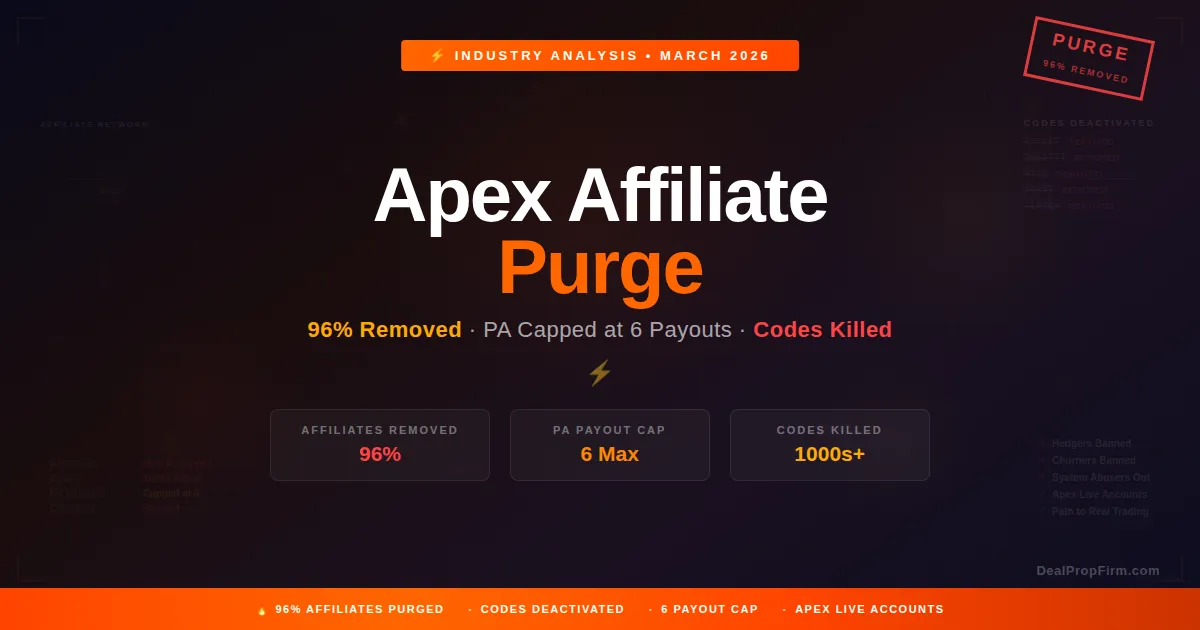
In early March 2026, Apex Trader Funding executed what is arguably the largest single affiliate program cleanup in the history of prop trading. According to the company's own statements, 96% of their entire affiliate network was removed in a single coordinated sweep. The scale is staggering: thousands of affiliates terminated, thousands of promo codes deactivated overnight, and an entire marketing ecosystem disrupted within days.
Promo codes that traders relied on for months — codes like ROCKET, BUGATTI, WISE, SMART, and countless others — simply stopped working. Affiliate dashboards went dark. Referral links redirected to generic pages. For many content creators and marketers who had built their income around Apex promotions, the purge was sudden and, in many cases, without individual warning.
Apex outlined several categories of behavior that triggered removal. First and foremost was deceptive marketing — affiliates who made misleading claims about guaranteed payouts, fabricated income screenshots, or misrepresented how the evaluation process works. Second was clickbait content, particularly YouTube thumbnails and social media posts designed to manipulate traders into signing up based on exaggerated promises. Third was cashback schemes, where affiliates would rebate a portion of their commission back to the trader as an incentive to use their code, effectively undermining Apex's pricing structure.
Perhaps the most controversial criterion was the fourth category: public attacks against the company. Apex stated that affiliates who publicly criticized the firm, spread what the company calls "misinformation," or participated in coordinated negative campaigns were removed regardless of their revenue contribution. This is a critical distinction — Apex explicitly stated that revenue generated no longer protects anyone. Even top-earning affiliates who brought in significant business were removed if they fell afoul of the new standards.
The company went further, establishing what amounts to a loyalty requirement: affiliates are now expected to actively defend Apex publicly or risk removal. This goes beyond the traditional affiliate relationship where the obligation is simply to drive sales honestly. Apex is now requiring its remaining affiliates to be public advocates for the brand, which has drawn criticism from industry observers who argue this blurs the line between independent marketing and corporate evangelism.
The timeline of the purge unfolded rapidly. Internal communications went out in late February 2026, but the actual deactivations began in the first week of March. By March 8, the vast majority of removed affiliates had discovered their status through failed promo codes and zeroed commission dashboards rather than through direct notification. Apex subsequently published public statements explaining the rationale, framing the purge as a necessary step to "protect traders from misleading information" and to "elevate the quality of the affiliate ecosystem."
The scale of this purge is unprecedented. No other prop trading firm has ever removed such a large percentage of its affiliate network in one action. For comparison, when FTMO restructured its affiliate program in 2024, the changes were gradual and primarily involved adjusting commission rates rather than mass terminations. Apex's approach is a scorched-earth strategy that prioritizes total control over incremental improvement.
Our status: The DEALPROPFIRM promo code remains fully active (90% OFF), confirming our compliance with Apex's updated affiliate standards. We have always maintained a factual, data-driven approach to our content — which is exactly the standard Apex now demands.
2. What This Means for Traders
If you're a trader who relied on a specific promo code and it suddenly stopped working, now you know why. The affiliate who provided that code was likely removed during the purge. This doesn't mean the discount is gone permanently — it means you need to find a code from an affiliate who survived the cleanup. Codes that still work, like DEALPROPFIRM (90% OFF) and DEALPROPFIRM, indicate that the affiliate behind them meets Apex's updated compliance requirements.
The practical impact on available promotions is meaningful. With 96% of affiliates removed, the total number of active discount codes has collapsed. Before the purge, there were hundreds — possibly thousands — of Apex promo codes circulating across YouTube, Twitter, Discord, Telegram, and TikTok. Now, only a small fraction remain. In theory, this means less competition on pricing, but in practice, the surviving codes still offer the same aggressive discounts. Apex's 90% OFF promotions remain the industry standard, so the actual cost to traders hasn't changed.
To verify whether a code is still active, simply enter it at checkout on the Apex website. If the discount applies, the code works. If you get an error message, the code has been deactivated. There is no public list of active vs. deactivated codes — verification is done at the point of purchase.
If your preferred discount code was deactivated, your options are straightforward. You can use any of the remaining active codes such as DEALPROPFIRM for the same 90% discount. The discount amount hasn't changed — a 25K evaluation still starts at approximately $16.70 with the code applied. The only difference is which affiliate gets credit for the referral.
There is a genuinely positive side to this purge for traders. The prop trading affiliate space had become increasingly polluted with misinformation. Affiliates with zero trading experience were producing content that misled beginners about the ease of passing evaluations, the likelihood of receiving payouts, and the overall risk involved. By removing these bad actors, Apex has effectively raised the quality floor for the information traders receive through affiliate channels. Whether this was their primary motivation or a convenient byproduct of a more control-driven strategy is debatable, but the outcome benefits traders either way.
Traders should also be aware that the surviving affiliates — including us — are now operating under stricter content guidelines. This means the information you receive from remaining Apex affiliates should be more accurate and less sensationalized. If an affiliate is still active, it's a signal that their content met Apex's review standards, which is a form of quality filter even if imperfect.
3. PA Payout Cap — 6 Payouts Per Account
Alongside the affiliate purge, Apex introduced a structural change to Performance Accounts (PAs): each PA is now limited to a maximum of 6 payouts. After the sixth payout is processed, the account is automatically closed and marked as "completed." This is a permanent change that applies to all new PA accounts going forward.
The math on this cap is worth examining carefully. With Apex allowing up to 20 active PA accounts simultaneously, the total payout capacity per trader is actually 120 payouts (20 accounts x 6 payouts each). Depending on account sizes and payout amounts, this translates to over $400,000 in potential withdrawals before a trader would need to pass new evaluations.
Here's a breakdown of what the 6-payout cap means at each account tier:
| Account Size | Max Payouts | Avg per Payout | Potential per Account |
|---|---|---|---|
| 25K | 6 | ~$2,000 | ~$12,000 |
| 50K | 6 | ~$4,000 | ~$24,000 |
| 100K | 6 | ~$7,000 | ~$42,000 |
| 150K | 6 | ~$10,000 | ~$60,000 |
| With 20 accounts (150K each) | 120 total | $400K+ | |
The question that divides the trading community is whether this cap represents a limitation or a progression. Both perspectives have merit, and the answer depends heavily on what kind of trader you are.
The Limitation View
- •Caps long-term sim traders who were consistently profitable on a single account
- •Forces account cycling — even successful traders must pass new evaluations after 6 payouts
- •Generates additional evaluation revenue for Apex on already-proven traders
- •Reduces the perceived value of each PA account since it now has a defined expiration
The Progression View
- •Encourages moving to live trading rather than staying on simulated accounts indefinitely
- •Prevents indefinite sim farming, which was a sustainability concern for the business
- •Creates a natural progression path: evaluation → PA → live account
- •Aligns incentives: traders who prove consistency get rewarded with uncapped live accounts
In reality, the practical impact of this cap is smaller than the headline suggests. Apex has acknowledged that very few traders ever reach 6 payouts on a single PA account. The attrition rate on funded accounts is extremely high — most traders lose their accounts within the first two payouts due to drawdown violations. The 6-payout cap primarily affects the small percentage of traders who demonstrate sustained profitability over months of consistent trading.
Let's do the math: if a trader consistently reaches 6 payouts on a single account, they have demonstrated the ability to manage risk, maintain profitability, and follow rules over an extended period. That trader is, by definition, a genuinely profitable trader. And for those traders, Apex has created a new destination: Live Accounts with no payout cap. The 6-payout cap on PAs is therefore less of a ceiling and more of a qualification round for the next level.
Whether you view this as a positive progression or a cynical revenue strategy depends on your perspective. The truth, as usual, likely falls somewhere in between. Apex needs to manage the financial sustainability of paying out simulated profits. Traders want unlimited upside on their funded accounts. The 6-payout cap with a Live Account pathway attempts to balance both interests, though reasonable people can disagree about whether it succeeds.
4. The Trader Purge — Who Gets Banned
The affiliate purge wasn't the only cleanup. Apex simultaneously announced a comprehensive wave of trader account bans targeting specific categories of behavior that the company considers abusive or detrimental to the program's integrity. The categories are clearly defined, though the boundaries between legitimate trading and "abuse" remain somewhat subjective.
Repeat violators are at the top of the list. Traders who have accumulated multiple rule violations across different accounts — whether for drawdown breaches, trading outside hours, or holding positions through restricted events — are now subject to account-wide bans rather than individual account closures. Previously, a trader could violate rules on one account and simply start another. That loophole has been closed.
Hedgers — traders who open opposing positions across multiple accounts to guarantee a profit on at least one — are explicitly targeted. This practice has always been against Apex's terms of service, but enforcement was inconsistent. The new wave of bans signals a more aggressive detection and enforcement strategy. Apex appears to be using pattern-matching algorithms to identify correlated trades across accounts held by the same individual.
Account churners represent a grey area that concerns many legitimate traders. Apex defines churning as cycling through accounts without demonstrating consistency — essentially, passing evaluations, taking one or two aggressive payouts, blowing the account, and repeating. The distinction between churning and legitimate account management is not always clear. A trader who passes an evaluation, takes a payout, then loses the account due to a bad trading day is not necessarily churning. But a trader who deliberately maxes out risk on every PA account with the expectation of losing most of them — relying on the law of large numbers to come out profitable — is engaging in what Apex considers systemic abuse.
System abusers includes traders who exploit technical loopholes in the platform — such as latency arbitrage, data feed manipulation, or timing exploits around evaluation resets. Gamblers, defined as traders displaying undisciplined behavior like all-or-nothing position sizing or consistently using maximum leverage without a coherent strategy, are also targeted.
Coordinated schemes — organized groups of traders working together to exploit the system — round out the ban categories. This includes copy-trading rings, signal groups designed to pass evaluations rather than trade profitably, and groups that share account credentials.
The consequences are severe: accounts are closed and all pending payouts are forfeited. There is no appeals process for traders flagged under these categories. This "zero tolerance" approach is a departure from Apex's historically more lenient enforcement and reflects the broader industry trend toward stricter compliance.
The concern for legitimate traders is real. The line between "account churning" and simply having a run of bad luck after a payout is thin. Apex has not published detailed criteria for how these determinations are made, which creates uncertainty. A trader who loses three consecutive PA accounts after taking profitable payouts on each could potentially be flagged as a churner, even if their trading was genuine. Until Apex provides more transparency on their detection methodology, this ambiguity will remain a point of friction.
5. Criticism = Ban? The Controversy
Perhaps the most polarizing element of Apex's March 2026 announcements is their stance on public criticism. Apex explicitly stated that traders who "attack" the firm publicly may have their accounts closed. The language used is important: Apex frames this not as silencing legitimate feedback but as targeting "defamatory claims" and "coordinated attacks" designed to harm the company.
The company has stated, in essence: "This is not an attempt to silence anyone. Feedback is welcome. But accounts will be closed for traders making defamatory claims or attacking the company with the intent to cause damage." On its face, this distinction between feedback and attacks seems reasonable. Every company has the right to protect itself from defamation. However, the practical application of this policy raises significant questions.
The fine line between legitimate criticism and what Apex considers an "attack" is not clearly defined. If a trader posts on social media that their payout was delayed and expresses frustration, is that feedback or an attack? If a YouTuber publishes a video analyzing Apex's payout statistics and concludes that the numbers don't add up, is that journalism or defamation? If a Discord community discusses problems with Apex's platform and the conversation turns negative, does that constitute a "coordinated attack"?
The chilling effect on community discussion is real. Traders who hold funded accounts with Apex now face a calculus that didn't exist before: speaking honestly about negative experiences could theoretically cost them their accounts and any pending payouts. This creates an incentive structure where funded traders are financially motivated to stay silent about problems, which is concerning for the broader trading community that relies on transparent information to make informed decisions.
Our position is clear: factual analysis, data-driven reporting, and transparent journalism are not "attacks." We report what happens, analyze the implications, and present both sides. That approach has kept our affiliate status intact through this purge, and it's the approach we will continue to take. If reporting facts constitutes an attack, then the problem lies with the facts, not the reporting.
How does this compare to other firms? TopStep, as an NFA-registered entity, has a more standardized approach to trader relations governed by regulatory frameworks. Most other prop firms maintain standard terms of service that restrict defamation but do not include the aggressive language Apex has used about "defending the company publicly." Apex's policy is an outlier in the industry.
From a legal standpoint, the question of whether a prop firm can terminate your account for speech is nuanced. Since prop trading firms operate as private companies and the trading relationship is governed by their terms of service, they generally have broad discretion to terminate accounts for any reason outlined in their agreements. However, if a trader suffers financial harm (forfeited payouts) as a direct result of exercising what they believe to be protected speech, the legal landscape becomes more complex. No test case has established precedent in this specific context, and the matter remains legally untested. For a deeper look at prop firm regulation, see our analysis of prop firm regulatory status.
6. Apex Live Accounts — The Real Opportunity
Amid the purges and restrictions, Apex introduced what may be the most significant development in their history: Apex Live Accounts. This new tier represents a fundamental shift from simulated trading to real brokerage accounts with real market execution. For traders who have been asking whether prop firm trading is "real," this is the answer Apex is providing.
Apex Live accounts operate under a Power of Attorney (POA) arrangement. The trader enters into an independent contractor agreement with Apex, and trades are executed on a real brokerage account owned by the company. The trader makes trading decisions and receives a share of the profits, while Apex provides the capital and assumes the risk. This structure is common in traditional proprietary trading firms but is relatively new in the retail-facing prop firm space.
The most critical detail: there is no payout cap on Live accounts. Unlike PA accounts, which are now capped at 6 payouts, Live accounts have no artificial limit on the number of withdrawals a trader can make. As long as you maintain profitability and follow the rules, you can continue trading and withdrawing indefinitely. This makes Live accounts the clear destination for traders who demonstrate sustained consistency.
Qualifying for an Apex Live account requires demonstrating discipline and consistency over time. While Apex has not published exact qualification criteria, the signals are clear: traders who reach 6 payouts on PA accounts (the new cap) have effectively proven their ability to trade profitably over an extended period. This makes the PA payout cap function as a qualification hurdle for Live account eligibility.
What changes when you go live? Several things. First, your trades are hitting real markets, which means you will experience genuine slippage, liquidity constraints, and price impact on larger positions. Simulated trading engines typically fill orders at the displayed price, which is not always possible in real markets, particularly during volatile conditions or with less liquid contracts. Second, the psychological element shifts — knowing that your trades are "real" can affect trader behavior, for better or worse. Third, your trading data becomes verifiable through independent brokerage statements, adding a layer of transparency that simulated accounts cannot match.
Why does this matter for the industry? The introduction of legitimate live funding options by a major prop firm is a step toward industry legitimacy. One of the persistent criticisms of prop trading firms is that simulated accounts don't represent real trading and that the business model relies on evaluation fees rather than trading profits. Apex Live accounts directly address this criticism by creating a pathway to genuine live trading. If other firms follow suit, it could fundamentally change how the prop trading industry operates and is perceived.
For a complete breakdown of Apex's new product structure including EOD and Intraday Trail evaluations, see our detailed analysis of the March 2026 rules update. For a broader view of Apex's offerings, visit our full Apex Trader Funding review.
7. How This Compares to Competitors
Apex's approach is unique in the prop trading landscape. No other major firm has executed a comparable purge of its affiliate network or implemented a per-account payout cap. To understand where Apex stands, it helps to compare their current position with the major competitors.
TopStep maintains a more restrictive but stable affiliate program. As an NFA-registered entity, TopStep operates under regulatory oversight that most prop firms lack. Their affiliate program has never undergone a mass purge because it was never as open as Apex's. TopStep also offers Express Funded accounts, their version of expedited live funding, though the program structure differs significantly from Apex's Live accounts.
Take Profit Trader (TPT) has no known payout cap and offers day-1 payouts — meaning traders can request a withdrawal from their very first profitable day on a funded account. Their profit split is 80/20 compared to Apex's 90/10, but the absence of payout restrictions makes TPT attractive for traders concerned about the 6-payout cap.
My Funded Futures (MFF) differentiates itself with a 100% profit split on the first $10,000 in withdrawals, after which it drops to a standard split. MFF has no known payout cap and has not conducted any affiliate purge. Their approach to affiliate management is more traditional, relying on performance-based metrics rather than content oversight.
| Feature | Apex | TopStep | TPT | MFF |
|---|---|---|---|---|
| Affiliate Purge | Yes (96%) | No | No | No |
| Payout Cap | 6 / account | None known | None | None |
| Live Trading | Yes (new) | Express Funded | No | No |
| Profit Split | 90/10 | 90/10 | 80/20 | 100% first $10K |
| Criticism Policy | Strict | Standard | Standard | Standard |
| NFA Registered | No | Yes | No | No |
Apex's model is now unique in the industry: a massive affiliate purge combined with a clear progression path from simulated to live trading. Whether this represents industry leadership or overreach depends on execution. If the Live Account program delivers real live trading with transparent execution and uncapped payouts, the restrictions on PAs and affiliates become more defensible. If the Live Account program remains difficult to access or underdelivers, the restrictions will look like cost-cutting dressed up as industry advancement.
For a comprehensive overview of all active deals and how different firms stack up on pricing, visit our active promos page. For more on affiliate practices in the prop trading industry, read our investigation into prop firm affiliate scams.
8. Our Take — Is This Good or Bad?
The March 2026 changes at Apex Trader Funding are the most consequential policy shifts in the company's history. They touch every stakeholder — affiliates, traders, and the broader industry. Our assessment is nuanced because the reality is nuanced.
What's Positive
- •Cleaning up fraudulent affiliates means traders receive better quality information and are less likely to be misled by clickbait and fake testimonials
- •Progression to live trading is a genuine sign of industry maturation — moving from pure simulation to real markets legitimizes the model
- •Less clickbait and fake testimonials means the overall quality of Apex-related content should improve
- •Fewer misleading promo offers reduces the confusion created by hundreds of competing codes with identical discounts
What's Concerning
- •The 6 payout cap limits high-performing sim traders who were building sustainable income from their PA accounts
- •The criticism-equals-ban policy raises serious questions about free speech and trader rights within the ecosystem
- •Requiring affiliates to defend Apex blurs the line between independent marketing and corporate advocacy
- •The purge could reduce pricing competition among affiliates, potentially leading to less favorable deals for traders
Our verdict: This is an authoritarian turn that simultaneously moves the industry toward professionalization. The two things are not mutually exclusive. Apex is tightening control over every aspect of its ecosystem — who markets their products, how traders talk about them, and how long traders can profit from simulated accounts. Some of these controls are overdue (affiliate cleanup). Others are overreaching (criticism bans). And some fall in a grey area (payout caps as progression incentives).
For serious traders, there is nothing to fear in these changes. If you trade with discipline, follow the rules, and don't engage in hedging schemes or account churning, the purge will not affect you. The 6-payout cap is a constraint, but for the vast majority of traders, it is irrelevant — reaching 6 payouts on a single PA account is already an achievement that fewer than 5% of funded traders accomplish. If you're in that elite category, the Live Account pathway is your next destination.
For churners and system abusers, the message is clear: the party is over. Apex is no longer tolerating strategies designed to exploit the sim-trading model rather than develop genuine trading proficiency. Whether you agree with their methods or not, the direction is unambiguous.
We will continue to monitor and report on these developments as they unfold. Our commitment is to factual, balanced analysis — reporting both the positive and negative aspects of every firm we cover. That approach has been validated by surviving the affiliate purge, and it's the standard we will maintain regardless of any firm's preferences about how their policies are discussed.
9. Frequently Asked Questions
Why did Apex remove 96% of affiliates?
Apex cited deceptive practices, clickbait marketing, cashback schemes, and public attacks on the company as reasons for the purge. The company stated that revenue generated no longer protects affiliates from removal — even top earners were terminated if they engaged in any of the flagged behaviors. The goal, according to Apex, is to elevate the quality of the affiliate ecosystem and protect traders from misleading information.
Is my Apex promo code still working?
If your promo code no longer works, the affiliate who provided it was likely removed during the purge. You can verify any code by entering it at checkout on the Apex website. Codes like DEALPROPFIRM (90% OFF) and DEALPROPFIRM remain active, indicating the affiliates behind them are in compliance with Apex's updated standards. The discount amount remains the same regardless of which active code you use.
What is the 6 payout cap on PA accounts?
Each PA (Performance Account) is now limited to 6 payouts. After the 6th payout is processed, the account is closed and marked as "completed." With up to 20 active accounts, traders can still access up to 120 total payouts, representing over $400K in potential withdrawals. The cap primarily affects the small percentage of traders who demonstrate sustained profitability over extended periods and is designed to encourage progression to Apex Live accounts.
Can Apex ban me for criticizing them?
Apex has stated that traders making "defamatory claims" or "attacking" the company may have their accounts closed. They frame this as targeting coordinated attacks rather than silencing feedback. However, the line between legitimate criticism and what Apex considers an "attack" remains debated. The policy has created a chilling effect where funded traders may hesitate to share honest negative experiences publicly.
What are Apex Live Accounts?
Apex Live Accounts allow qualifying traders to transition from simulated trading to real brokerage accounts. Trading is done under a Power of Attorney (POA) arrangement with an independent contractor agreement. The key advantage: there is no payout cap on Live accounts, making them the ultimate destination for consistently profitable traders. Qualification requires demonstrating sustained discipline and profitability on PA accounts.
Is the DEALPROPFIRM code still active?
Yes. The DEALPROPFIRM promo code remains fully active, offering 90% OFF all Apex evaluations. This confirms that we are in full compliance with Apex's updated affiliate program requirements. The code works on all account sizes and evaluation types, including both EOD and Intraday Trail products.
Get 90% OFF Apex Evaluations
The DEALPROPFIRM code survived the affiliate purge and remains fully active. Start from $16.70 on 25K accounts. Code DEALPROPFIRM is also available.
Affiliate Disclosure: DealPropFirm earns a commission when you sign up through our affiliate links. This does not affect the price you pay. All analysis and opinions expressed in this article are based on independent research. We maintain editorial independence and our affiliate relationships do not influence our coverage. For more details, see our full affiliate disclosure.