01Our Methodology
Registries Checked
NFA BASIC
National Futures Association — US derivatives self-regulatory organization
nfa.futures.org/BasicNetFCA Register
UK Financial Conduct Authority (checked for completeness, US firms not expected)
We searched each registry using the firm's brand name, legal entity name, and known variations. Each search was performed manually between March 8-10, 2026. All links in this article point directly to the source so you can verify every claim yourself.
Important context: Most futures prop firms route trader orders through NFA-registered Futures Commission Merchants (FCMs) like NinjaTrader/Tradovate, Rithmic, or Plus500. The firms themselves typically operate as technology/evaluation companies — which is why most are not directly registered.
02Results — The Full Regulatory Check
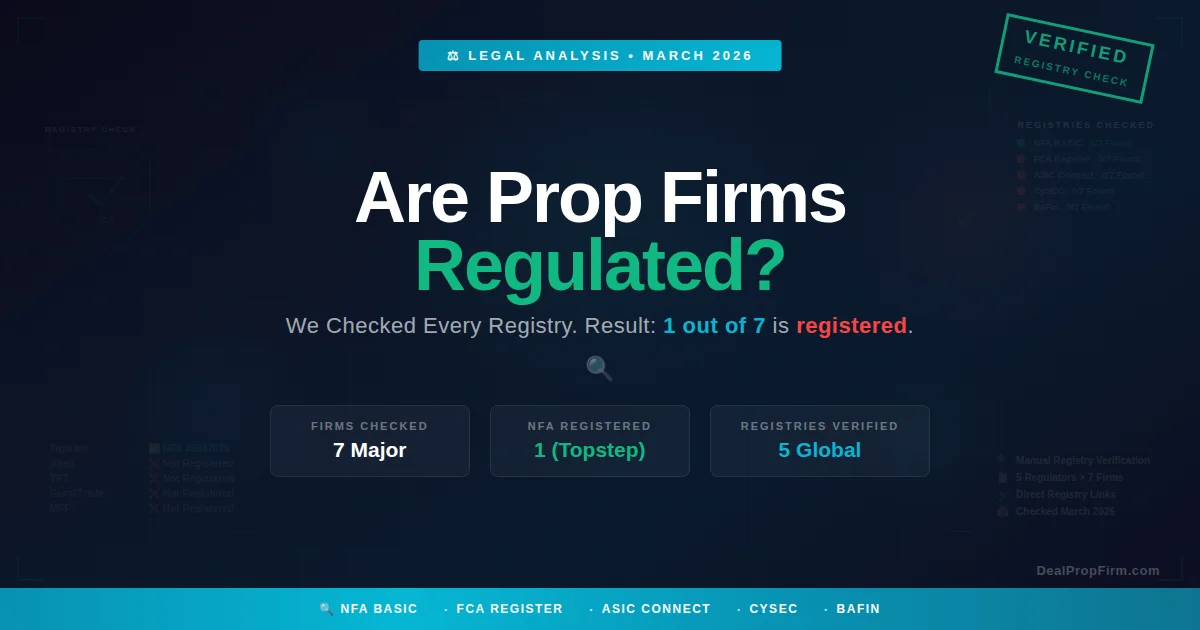
Out of 7 major US futures prop firms checked, only Topstep holds NFA registration. None have SEC filings (all are private companies), and none have CFTC enforcement actions on record.
| Firm | NFA | SEC | CFTC Actions | Founded | Trust Score |
|---|---|---|---|---|---|
| Apex Trader Funding | Not registered | None | Clean | 2021 | 87/100 |
| TopStep | Registered#0567079 | None | Clean | 2012 | 100/100 |
| Take Profit Trader | Not registered | None | Clean | 2021 | 85/100 |
| Earn2Trade | Not registered | None | Clean | 2016 | 75/100 |
| My Funded Futures | Not registered | None | Clean | 2023 | 75/100 |
| Tradeify | Not registered | None | Clean | 2024 | 70/100 |
| Elite Trader Funding | Not registered | None | Clean | 2022 | 70/100 |
| SabioTrade | Not registered | None | Clean | 2022 | 75/100 |
| Bulenox | Not registered | None | Clean | 2022 | 75/100 |
| DNA Funded | Not registered | None | Clean | 2024 | 60/100 |
| ThinkCapital | Not registered | None | Clean | 2024 | 65/100 |
| FXIFY | Not registered | None | Clean | 2022 | 70/100 |
How to verify: Click any firm name to see their full review. Each review page includes a Regulatory & Financial Data widget with direct links to source registries. We encourage you to verify these findings independently.
03How Your Money Actually Flows
To understand why most prop firms aren't registered, you need to understand where your money actually goes. Most traders have no idea how many companies are involved between them clicking "Buy" and an order hitting the CME.
The chain from your wallet to the exchange
You pay $150 for a 50K evaluation
Prop Firm (e.g. Apex) — Not regulated (not required)
This is a software subscription, not an investment. The firm sells access to a trading evaluation platform.
You pass the evaluation and get a "funded account"
Prop Firm — Not regulated (not required)
The firm gives you access to trade their capital (or simulated capital — more on this in section 5). You don't deposit anything.
Your trades are routed to an FCM
FCM (e.g. NinjaTrader, Tradovate, Rithmic) — NFA/CFTC regulated
The FCM is NFA-registered and handles order execution, clearing, and settlement. This is where regulation kicks in.
The FCM sends orders to the exchange
Exchange (CME, CBOT, NYMEX) — NFA/CFTC regulated
The exchange matches buyers and sellers. Fully regulated by the CFTC.
The key insight: Your actual trades are always executed through regulated entities (FCMs and exchanges). The prop firm itself sits before this regulated chain — it's the gateway, not the executor. This is why the NFA doesn't require prop firms to register: they're selling evaluation access, not executing trades or holding customer funds.
This also means that your trades are real (when using live capital) — they go through the same regulated infrastructure as any retail futures trade. The difference is whose capital is at risk: the firm's, not yours.
04What "Not Registered" Actually Means
Before you panic: being unregistered is not illegal, and it doesn't mean a firm is a scam.
Most prop firms operate as technology or evaluation companies. They don't hold client deposits in the traditional sense — traders pay for an evaluation, and if they pass, they trade the firm's capital (or simulated capital). This business model doesn't typically trigger the legal requirements that mandate NFA/SEC registration.
Key distinctions
- 1.Futures Commission Merchants (FCMs) — must be NFA registered. These are the firms that actually execute and clear trades. NinjaTrader/Tradovate, Rithmic, and Plus500 are NFA-registered FCMs that prop firms use.
- 2.Introducing Brokers (IBs) — must be NFA registered. They introduce clients to FCMs. Topstep Brokerage LLC is registered as an IB.
- 3.Evaluation/Technology companies — no registration required. This is how most prop firms operate. They sell evaluation subscriptions and provide access to funded accounts through registered FCMs.
That said, registration does provide an additional layer of oversight and trader protection. It means the firm submits to audits, maintains capital requirements, and follows reporting obligations. It's a meaningful differentiator — just not a dealbreaker.
05Simulated vs Live Capital: The Hidden Distinction
Here's something most prop firm marketing won't tell you clearly: not all "funded" accounts use real money. This distinction has massive implications for regulation, for your payouts, and for what happens if the firm disappears.
Live Capital Model
- +Your trades hit real markets with real firm capital
- +Profits come from actual market gains
- +Firm has skin in the game — they lose money if you blow up
- ~Closer to traditional prop trading (think Jane Street, Jump Trading)
Used by: Topstep (via Plus500 FCM), some Apex accounts (Path to Live)
Simulated Capital Model
- ~Your trades may not hit real markets
- ~Payouts come from the firm's evaluation fee revenue pool
- ~The firm profits when traders fail evaluations (majority do)
- ~Business model closer to a contest/competition than traditional trading
Used by: Most evaluation-based firms during the evaluation + initial funded phase
Why this matters for regulation: If a firm uses simulated capital, there's genuinely less need for financial regulation — no real money is at risk in markets. The firm is essentially running a performance contest. But if a firm claims to use live capital, the regulatory picture changes: they're managing real positions in real markets, which is closer to traditional brokerage activity.
Why this matters for you: In a simulated model, the firm's ability to pay you depends on their overall revenue (evaluation fees from all traders) minus payouts to successful traders. If a firm scales too fast and pays out more than it collects, it goes under — exactly what happened to dozens of firms in 2024. This is why payout track record and financial health matter more than a regulatory badge.
Most firms use a hybrid approach: simulated accounts for evaluation and early funded phases, transitioning to live capital for consistently profitable traders. Topstep and Apex (with its new Path to Live Trading) are the most transparent about this distinction.
06Why Topstep Is Different
Topstep is the only major prop firm in our analysis with NFA registration. Their brokerage arm, Topstep Brokerage LLC, is registered as an Introducing Broker (IB) with NFA ID #0567079.
What NFA registration means for traders
- +Regular financial audits and compliance reviews
- +Capital adequacy requirements
- +Mandatory reporting to the CFTC
- +NFA arbitration available for disputes
- +Membership in the Futures Industry Association (FIA)
Founded in 2012, Topstep is also the oldest firm in our analysis. Their partnership with Plus500 (LSE: PLUS), a publicly-traded company, provides additional financial backing and transparency. This combination of regulatory status, longevity, and institutional backing is unique in the prop firm space.
07How to Check Any Prop Firm Yourself
Don't take our word for it. Here's exactly how to verify any prop firm's regulatory status in under 5 minutes. These are the same steps we used for this investigation.
Check NFA BASIC (US Futures)
- Go to nfa.futures.org/BasicNet
- Click "NFA Member" in the search options
- Type the firm name (try variations: "Topstep", "Topstep LLC", "Topstep Brokerage")
- If found: note the NFA ID, registration category, and status
- If not found: try the parent company name or the CEO's name as an Associated Person
Pro tip: If a firm claims to be "NFA registered" on their website, search their exact NFA ID. Some firms list their FCM partner's NFA ID as if it were their own — that's misleading.
Check SEC EDGAR (Public Filings)
- Go to SEC EDGAR Full-Text Search
- Search the firm name in quotes: "Apex Trader Funding"
- Most prop firms won't appear — they're private LLCs with no public securities
- If found: check the filing types (10-K = annual report, 8-K = material event)
Don't expect to find prop firms here. SEC filings are for public companies or those raising capital through securities. A prop firm with SEC filings would actually be unusual.
Check CFTC Enforcement Actions
- Go to cftc.gov/enforcement
- Use Ctrl+F (or Cmd+F) and search the firm name
- Also search the CEO/founder's name — enforcement actions are against individuals too
- This is the most important check. No NFA registration is fine. But a CFTC enforcement action is a serious red flag.
Example: MyForexFunds had CFTC action in 2023 (later dismissed). Read the full story.
Bonus: Check State Business Registration
- Every legitimate US company is registered with their state
- Texas: comptroller.texas.gov (Apex)
- Illinois: ilsos.gov (Topstep)
- Florida: sunbiz.org (Take Profit Trader, Tradeify)
- Wyoming: wyobiz.wyo.gov (Earn2Trade)
- If you can't find the company in any state registry — that's a red flag
State registration doesn't mean financial regulation. It just confirms the company legally exists. But a firm that doesn't exist on paper is one you should avoid entirely.
08Regulation Is Coming
The regulatory landscape for prop firms is shifting. After the 2024 collapse that shut down 80+ firms, regulators are paying closer attention. But regulation for prop firms didn't start with government agencies — it started with a software company.
The timeline of enforcement
MetaQuotes revokes MT4/MT5 licenses
MetaQuotes, the company behind MetaTrader, started revoking platform licenses from prop firms serving US clients without proper regulation. This wasn't government action — it was a private company deciding who could use their software. The result was devastating: dozens of firms lost access to MT4/MT5 overnight, forcing them to shut down or scramble to alternative platforms.
CFTC sues MyForexFunds
The CFTC brought action against MyForexFunds, alleging fraud. Plot twist: the court later found the CFTC's evidence was flawed, sanctioned them $3.1M, and dismissed the case with prejudice. Full investigation here. This case showed that regulators are watching prop firms — but also that regulatory overreach is a real risk.
80+ prop firms shut down
The combined effect of MetaQuotes revocations, regulatory pressure, and poor business models caused the largest collapse in prop firm history. This pushed the industry toward futures-based platforms (which don't depend on MetaQuotes) and more sustainable business practices.
Apex announces Path to Live Trading
Apex's new program transitions profitable traders from simulated to live accounts — a voluntary step toward the regulated model that Topstep already uses. See our March 2026 analysis.
CFTC framework expected
The CFTC has signaled interest in establishing clearer rules for evaluation-based prop firms. Full frameworks may take 1-2 years to implement, but the direction is clear: more oversight is coming.
In the meantime, our PropFiles investigation system tracks firm behavior and flags issues before they become problems. Community-driven oversight is filling the gap that regulation hasn't yet covered.
09What Registration Won't Protect You From
Even if every prop firm became NFA-registered tomorrow, it wouldn't solve every problem. Here are the real risks that no registration can prevent — and what you should actually watch for.
Rule changes that make payouts impossible
A firm can add consistency rules, trailing drawdown changes, or "maintenance fees" that make it nearly impossible to withdraw profits. This is legal even for registered firms. Watch for: firms that change rules retroactively on existing accounts.
Slow payouts that never arrive
Payout processing times that creep from 3 days to 7 days to 14 days to "under review" indefinitely. This was the first warning sign for nearly every firm that collapsed in 2024. Watch for: any increase in published payout timelines.
Evaluation price races to the bottom
When firms compete on price instead of quality, they attract more traders but collect less revenue per person. If payouts exceed revenue, the firm goes under. A $25 evaluation for a 150K account sounds great — until the firm can't pay its winners. Watch for: prices that seem too good to be true.
Influencer-driven growth without substance
Firms paying influencers 30-50% commissions to drive signups. This isn't inherently bad, but when marketing spend exceeds the firm's ability to pay traders, it's a Ponzi-like structure. Watch for: firms you only hear about through paid promotions.
"Funded" accounts that are actually demo accounts with rules
Some firms run traders on demo/simulated accounts even after the "funded" phase, then pay from the evaluation fee pool. This is legal and common, but traders should know what they're getting. Watch for: firms that are vague about whether your capital is real or simulated.
The bottom line: Registration is a positive signal, not a guarantee. The best protection is a combination of regulatory status, proven payout history, transparent rules, and community accountability. That's exactly what our Trust Score measures — and why we built PropFiles to track firm behavior over time.
10Our Recommendation
Regulatory status is one factor among many when choosing a prop firm. A firm's payout track record, rule transparency, company age, and community reputation matter just as much — sometimes more.
Our picks based on different priorities
Topstep — NFA registered, 14 years of operations, institutional backing from Plus500. Trust Score: 95/100.
Apex Trader Funding — not registered, but 4+ years of consistent payouts, $100M+ paid to traders, strong community. Use code DEALPROPFIRM for the best deal. Trust Score: 80/100.
Take Profit Trader — industry-leading same-day payouts. Trust Score: 75/100.
Our Trust Score combines all these factors into a single metric: regulatory status, payout history, company age, team size, user reviews, and CFTC enforcement record. Use it as a starting point, then dive into our detailed reviews and risk calculator to make an informed decision.
11Frequently Asked Questions
Are prop firms regulated?
+
Is Apex Trader Funding regulated?
+
Which prop firms are NFA registered?
+
Is it safe to trade with an unregulated prop firm?
+
Will prop firms be regulated in 2026?
+
What is the NFA?
+
Do prop firms manage client funds?
+
What is a Trust Score?
+
Compare All Prop Firms
Use our free tools to find the right prop firm for your trading style, with full regulatory data and Trust Scores.