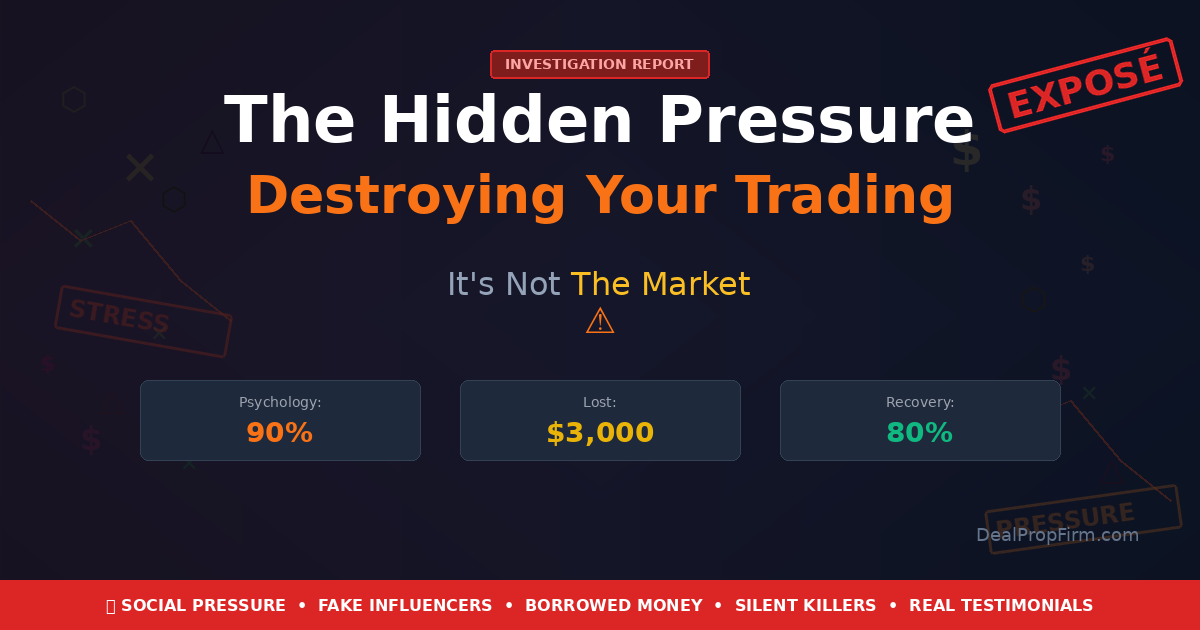
The Silent Killers
"You can have the perfect strategy, the best risk management, and years of chart study — and still blow every account you touch."
The problem isn't the market. The problem isn't your strategy. The problem is the invisible pressure you carry every time you open a trade.
Nobody talks about this because it's not "sexy" content. No Lamborghinis. No "I made $50K this week." Just raw, uncomfortable truth that most traders refuse to acknowledge until it's too late.
Today we're exposing the silent killers that destroy more accounts than any bad strategy ever could. These are the pressures that turn profitable traders into gambling addicts, that make rational people ignore their stop losses, that create the revenge trading spirals you swore you'd never fall into.
And we're not going to sugarcoat it. Because if you don't understand these pressures — if you don't learn to identify and eliminate them — you will fail. Not might. Will.
Let me share a real story from a trader who learned this the hardest way possible...
Featured Story
From $500 in Signals to $3,000 in Debt: A Trader's Confession
— Ilham, Indonesia, December 2025
"Halo bro, let me introduce myself. My name is Ilham from Indonesia, and I'm a university student. I first got to know trading around June 2025, which means about six months ago. When I first entered trading, I was introduced to signal trading. At that time, I couldn't analyze the market on my own, so all I did was follow signals from other people. From those signals, I ended up losing around 500 dollars.
After realizing that trading can't be done by relying solely on signals from others and that I had to build my own understanding, I started joining trading mentors in Indonesia. I probably spent around 500 to 600 dollars paying for various classes from different mentors. From them, I learned a lot. After that, I decided to trade on a real account. During that learning journey, while still studying with mentors, I suffered losses of about 1,000 dollars. I considered that as tuition, money spent to learn.
However, what I didn't realize and what became my biggest mistake was that the 1,000 dollars I lost was actually my last money. After it was gone, I had nothing left. That's when I decided to take out a loan. This was my biggest mistake. Trading with borrowed money seriously affects your psychology. That was the starting point of my collapse.
I borrowed 3,000 dollars with the belief that I had already studied, already had the knowledge, and that paying back 3,000 dollars would be easy. But I was wrong. Trading with money that comes from debt increases psychological pressure, and that pressure destroys your mindset. Eventually, the entire 3,000 dollars from the loan was gone. I truly had nothing left to repay the debt.
From that point on, my life started to fall apart. Everything became chaotic. Until now, I've been clinging to giveaways, joining one after another, hoping I could get some money to pay off my debts. Ironically, my original goal in trading was to change my family's life. My family is not wealthy. As the only son in my family, I was determined to make my family happy. But the steps I took were too big and too reckless.
Now I realize that I must change. I already know where my mistakes were. At this point, I've proven through backtesting results and competition accounts that I can grow an account and show solid performance, achieving significant equity growth on competition or free accounts, with an 80 percent win rate based on my backtests.
That is my trading journey up to now. I'm still trying to improve my life and my family's future. I hope this story can inspire others, especially to never, ever trade using borrowed money."
Ilham's story contains EVERY pressure we're about to break down:
- →Signal dependency ($500 lost)
- →Mentor costs ($500-600 spent)
- →"Tuition money" mindset ($1,000 lost)
- →Borrowed money trading ($3,000 gone)
- →Family pressure (only son, wanted to help family)
- →Desperation cycle (giveaways to pay debt)
- →BUT: Redemption (80% win rate on backtests now)
We've Been There Too
Before you think we're just another website telling you what to do — let us be clear: we've been through this.
We've lost money. A lot of it. Before we ever made consistent profits, we went through the same cycles Ilham described. The overtrading. The revenge trading. The "just one more trade to make it back." The sleepless nights calculating how we'd recover from losses we couldn't afford.
We've felt the pressure of family asking about our "gambling hobby." We've compared ourselves to fake influencers and wondered why we couldn't replicate their results. We've set impossible deadlines and destroyed ourselves trying to meet them.
This is why we created DealPropFirm. Not to sell you a $2,000 course. Not to show off fake screenshots. But to give you the honest information we wish we had when we started.
We're not "gurus." We're traders who struggled, who failed, who learned the hardest lessons through experience. And we want to help others avoid the years of pain and thousands of dollars we lost to these invisible pressures.
"If we had understood this earlier, we would have saved years and thousands of dollars."
The 5 Invisible Pressures
The forces that destroy more accounts than any bad strategy
1Family & Social Pressure
"So... how's the trading going?"
"My original goal in trading was to change my family's life. My family is not wealthy. As the only son in my family, I was determined to make my family happy."
— Ilham
You know the scene. Sunday dinner. Your uncle asks what you've been up to. You mention trading and suddenly everyone has an opinion. "Isn't that just gambling?" "My friend's cousin lost everything." "When are you going to get a real job?"
Or worse: you've told your family you're going to "make it" in trading. Now every dinner is an accountability session you never signed up for. Every question about your progress feels like judgment. Every loss feels like letting everyone down.
This pressure is insidious. It doesn't show up on your charts. It doesn't appear in your trading journal. But it's there — sitting in the back of your mind — every time you open a position. And it leads to the deadliest mistake: trading to prove something to others instead of trading your system.
- •The shame of losing leads to emotional, revenge trades
- •The pressure to "prove them wrong" creates reckless risk-taking
- •The need to show results forces trades that aren't there
- •Being the "only hope" (like Ilham) creates unbearable psychological weight
⚠️ When you trade to prove something to others, you've already lost.
The Solution:
Compartmentalize. Don't share your trading results with family. Don't make promises about future profits. Trade for yourself, not to impress. Your family doesn't need a weekly P&L update — and honestly, neither does your ego.
2Fake Influencer Pressure
"I made $50K this week trading from my Lambo"
Open Instagram. Open Twitter. Open YouTube. Within 30 seconds, you'll see someone flexing their trading gains next to a sports car, a yacht, or a Dubai penthouse. Screenshots showing $100K profits. "I quit my 9-5 in 3 months." "Trading changed my life."
What they don't show you: the Photoshopped screenshots. The rented Lamborghinis. The fact that most of their income comes from selling courses, not trading. The losses. The blown accounts. The years of failure before any success.
The Truth:
Most trading influencers make money selling courses, not trading.
Ilham spent $500-600 on mentors before he realized he needed to learn on his own. He lost $500 on signals from people who claimed to have the secret. This is the industry. This is the game.
When you compare yourself to these people, you're comparing yourself to fiction. You're measuring your real, messy, struggling journey against a curated fantasy. And that comparison creates expectations that are impossible to meet.
- •Photoshopped screenshots create false benchmarks
- •$2000 courses teach $50 worth of free information
- •Lifestyle flexing makes your progress feel worthless
- •You compare yourself to people who don't actually trade
The Solution:
Unfollow aggressively. Remove anyone who makes you feel bad about your progress. Focus on your own journal, your own data, your own improvement. The only person you need to beat is who you were yesterday.
3Financial Pressure — The Account Killer
"Trading with rent money"
"Trading with money that comes from debt increases psychological pressure, and that pressure destroys your mindset."
— Ilham
This is the single most destructive pressure in trading. It's also the most common. And it's exactly what destroyed Ilham.
When you trade with money you can't afford to lose — rent money, bill money, borrowed money — every single trade becomes life or death. Your stop loss isn't a risk management tool anymore. It's a decision about whether you can pay rent this month. It's whether you can make your debt payment.
NEVER trade with borrowed money. Ever. This is non-negotiable.
The Cruel Math:
- 1.$3,000 borrowed
- 2.Psychological pressure = bad decisions
- 3.Bad decisions = losses
- 4.Losses = MORE pressure
- 5.More pressure = WORSE decisions
- →Result: $0 balance + debt to repay
It's a death spiral. Once you're in it, there's almost no way out without external intervention. The pressure compounds with every loss, making rational decision-making impossible.
The Solution:
- •Trade ONLY with money you can truly afford to lose
- •Use prop firms — their capital, not yours
- •Separate your trading account from your living expenses completely
- •Start small. Prove consistency before scaling
4Time Pressure
"I need to quit my job in 6 months"
You've set a deadline. "I'll be consistently profitable by March." "I need to make $5K this month or I'm quitting." "If I don't pass this challenge by the expiration date, I'm done."
"The steps I took were too big and too reckless."
— Ilham
The market doesn't care about your calendar. Opportunities don't appear because you need them to. When you impose artificial deadlines on your trading, you force trades that aren't there. You take setups that don't meet your criteria because "you need to hit your target."
This pressure leads directly to overtrading. When your internal clock is ticking, you see opportunities where there are none. You enter too early, exit too late, and make decisions based on desperation instead of analysis.
- •Self-imposed deadlines force bad entries
- •"If I don't make X this month" = overtrading guaranteed
- •The market doesn't respect your calendar
- •Time pressure turns strategy into gambling
The Solution:
Remove ALL time-based expectations. Trading is a marathon, not a sprint. Focus on the process, not the timeline. You'll be profitable when you're ready, not when your calendar says you should be.
5Comparison Pressure
"He made it in 3 months, why not me?"
You see someone on Twitter announce they passed their prop firm challenge in 2 weeks. Someone else posts about making $10K in their first month funded. Another trader shows their journey from $500 to $50K in a year.
What you don't see: the hundreds who failed quietly. The survivorship bias that makes success look more common than it is. The context — years of prior experience, existing capital, external income, or simply luck that won't replicate.
When you compare your chapter one to someone else's chapter twenty, you will always feel like a failure. And that feeling bleeds into your trading. You take bigger risks because "they did." You expect faster results because "everyone else gets them."
- •You only see the survivors, not the 90% who failed
- •Everyone's path is different — backgrounds, capital, time available
- •People only share wins, never losses
- •Comparison creates unrealistic expectations
The Solution:
Compete only with yourself from yesterday. Your sole benchmark should be: "Am I better than I was last week?" That's it. Everyone else's journey is irrelevant to yours.
The Destruction Cycle
Why Pressure Destroys Your Trading — The Science
The Death Spiral: Once it starts, it accelerates until everything is gone
The Science:
When you're under pressure, your body produces cortisol — the stress hormone. Cortisol triggers your fight-or-flight response. Your thinking becomes short-term. Your prefrontal cortex (rational thinking) gets overridden by your amygdala (emotional reactions).
This is great if you're running from a lion. It's disastrous if you're trying to follow a trading plan. You trade to escape the pain of pressure, not to execute your strategy. You become reactive instead of proactive.
Symptoms That You're Trading Under Pressure:
If you checked 3 or more, you're trading under pressure. Step away. Now.
The Detachment Framework
How to Trade Without Pressure
The solution isn't to "manage" pressure. You can't out-willpower cortisol. You can't discipline your way through fight-or-flight mode. The solution is to eliminate the pressure entirely.
1. Financial Detachment
- ✓Trade with capital you can genuinely afford to lose — not theoretically, actually
- ✓Use a prop firm — their capital means your personal finances stay protected
- ✓Separate your trading account from your living expenses completely
- ✓Never add more capital when you're losing — that's the desperation talking
2. Social Detachment
- ✓Stop sharing your trading results with family and friends
- ✓Unfollow the fake lifestyle traders — ruthlessly
- ✓Find a real community of traders (not course sellers)
- ✓Your family doesn't need to know about every trade
3. Time Detachment
- ✓Remove ALL deadlines for profitability
- ✓Focus on the process: "Did I follow my rules?" not "Did I make money?"
- ✓"I'll be profitable when I'm ready, not when I need to be"
- ✓Measure progress in skill development, not P&L
4. Ego Detachment
- ✓A losing trade doesn't mean you're a loser
- ✓Stop comparing yourself to others entirely
- ✓Journal your emotions, not just your trades
- ✓Be willing to be wrong — that's how you learn
5. Outcome Detachment
- ✓Your goal: execute your plan perfectly
- ✓NOT: make money on this specific trade
- ✓Profits are a consequence of good execution, not the objective
- ✓A good trade can lose money. A bad trade can make money. Focus on the process.
Ilham's Redemption
There's Hope
"Now I realize that I must change. I already know where my mistakes were. At this point, I've proven through backtesting results and competition accounts that I can grow an account and show solid performance, achieving significant equity growth on competition or free accounts, with an 80 percent win rate based on my backtests."
— Ilham
Ilham isn't a success story yet. He's still rebuilding. But look at what he's doing differently:
What He's Doing Now
- • Rigorous backtesting before live trading
- • Competition/demo accounts (no real money risk)
- • 80% win rate proven on paper
- • No financial pressure from borrowed money
What He Stopped Doing
- • Trading with borrowed money
- • Following signals blindly
- • Paying for expensive mentors
- • Rushing to prove himself to family
He removed the pressures. He's focusing on the process. He's proving his edge before risking real capital. This is the path.
His story isn't over. Neither is yours.
Start Today
Your Action Plan:
- 1Identify YOUR primary pressure — Is it family? Money? Time? Comparison? Be honest.
- 2Take ONE action to reduce it today — Unfollow someone. Stop sharing results. Remove a deadline.
- 3If you're trading with money you can't afford to lose — STOP — Right now. Close the position. Step away.
Resources:
Trading Psychology Guide
The 6 pillars of trading mindset
Prop Firms
Trade with their capital, not yours
Risk Calculator
Size your positions properly
The market will always be there.
Your mental health might not be. Trade accordingly.
And to Ilham, and everyone else fighting this battle: you're not alone. Keep going.